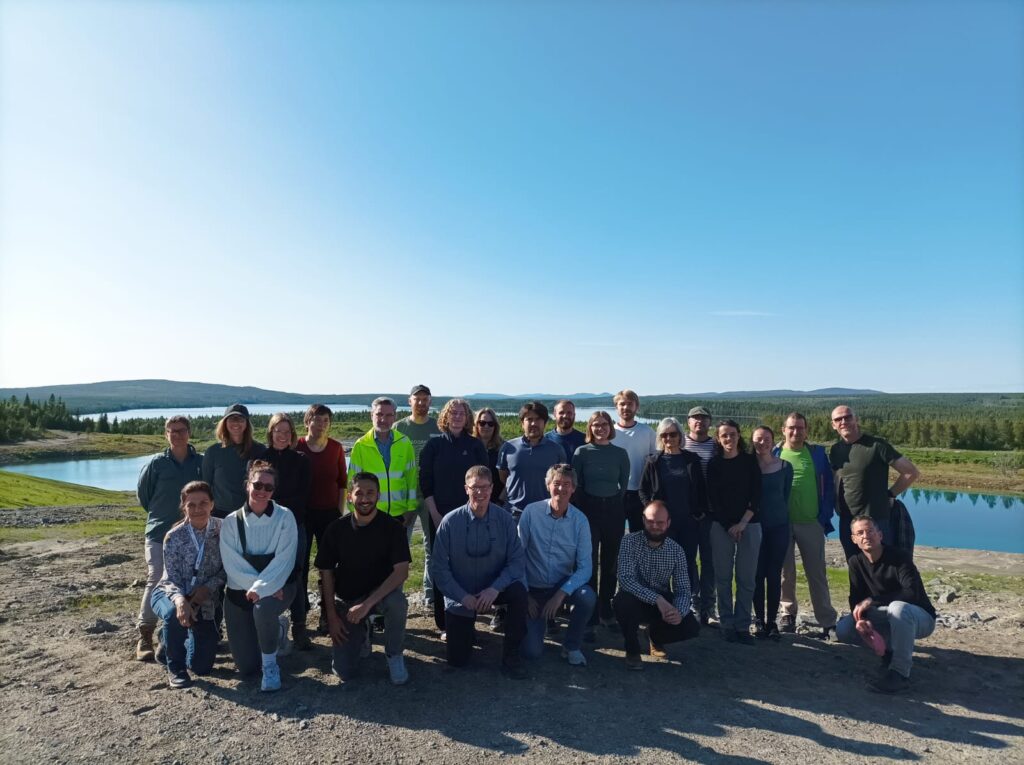
At the end of June, the FutuRaM project convened its bi-annual consortium meeting in Skellefteå, a historic mining town nestled in the north of Sweden. With nearly 50 participants in attendance, the meeting brought together project partners from across Europe for lively discussions, in-depth case studies, and unique field experiences – followed by an immersive tour through the local mining landscape.
FutuRaM Project Progress
The event began with a warm welcome from Erik Ronne of Boliden and James Horne of the WEEE Forum, who set the scene by introducing Boliden’s regional operations and their relevance to FutuRaM’s mission. The morning quickly moved into technical territory with presentations of three UNFC case studies at the heart of the project. Tuomas Leskelä from the Geological Survey of Finland (GTK) introduced the Otanmäki ilmenite tailings study, while Franziska Maisel and Max Tippner from Technische Universität Berlin offered long-range insights into battery stocks and flows in Germany through to 2050. Serge Kimbel then presented WEEECycling’s site-specific case on CRM recovery from electronic waste, giving participants a practical look into how theory meets industrial application.
Adding further depth, Vera Susanne Rotter and her team from TU Berlin led a well-received workshop on extending FutuRaM’s methodologies for assessing waste stream composition. Their work is crucial for better understanding the recoverability of secondary raw materials from complex and often underexplored sources.
One of the many benefits of gathering in Skellefteå was the close connection to Boliden’s operations. Åke Roos, Head of Waste Valorisation Research and former CEO of the Rönnskär smelter, delivered a compelling talk on how smelter waste streams are being transformed into valuable materials. This was followed by Ulf Degerstedt, Boliden’s Manager of Process Development, who guided participants through the company’s state-of-the-art processes for recovering secondary raw materials from WEEE at Rönnskär.
On the second day, the focus turned to tools, platforms, and methodologies developed under FutuRaM. Updates were shared on the redesigned Urban Mine Platform, the project’s growing knowledge base on secondary raw materials. Partners also explored how life cycle and social life cycle assessments are being applied across various waste scenarios, from batteries and WEEE to end-of-life vehicles, construction and demolition waste, and mining residues. The importance of FAIR data management and the upcoming final project report – due in mid-2026 – rounded out the day’s discussions.
Field Trips Around Skellefteå
But the experience didn’t end there. Taking full advantage of the location, the group spent the following two days exploring the region’s mining heritage and current operations. Guided by our Boliden hosts, partners visited a wide range of sites – from historic closed mines like Rävliden, Näsliden, and Kjedträsk to active mines in Renström and Kankberg. The tour also included tailings sites at Hötjärn and Gillervattnet, which offered a glimpse into the scale and potential of Europe’s historical mining waste.
A visit to the SGU drill core archive added another layer to the experience. Housing over 4.5 million metres of drill cores – some more than a century old – the archive is a national treasure for geological research and an invaluable reference for FutuRaM’s work.
Beyond the technical programme, participants were invited to connect with the region in a more personal way. A nature walk through the boreal landscape, complete with reindeer sightings, offered a chance to reflect on the local environment. That evening, a traditional Sami dinner provided both nourishment and a moment of cultural exchange that many will not soon forget.
As the week came to a close, partners departed Skellefteå with renewed energy, fresh insights, and a deeper appreciation for the communities and landscapes connected to Europe’s resource story. Special thanks go to Erik Ronne for his generous hospitality and to Ronald Arvidsson for sharing his deep knowledge of local geology. While the project’s final destination is still on the horizon, our time in Sweden marked a meaningful milestone on the journey.